
Lata Night Chart History – Past Results & Trends Analysis (Complete Guide)
Explore the history of the Lata Night Chart, including how past results shaped trends, pattern analysis techniques, and insights for better understanding chart movement over time.
 TechViaMark
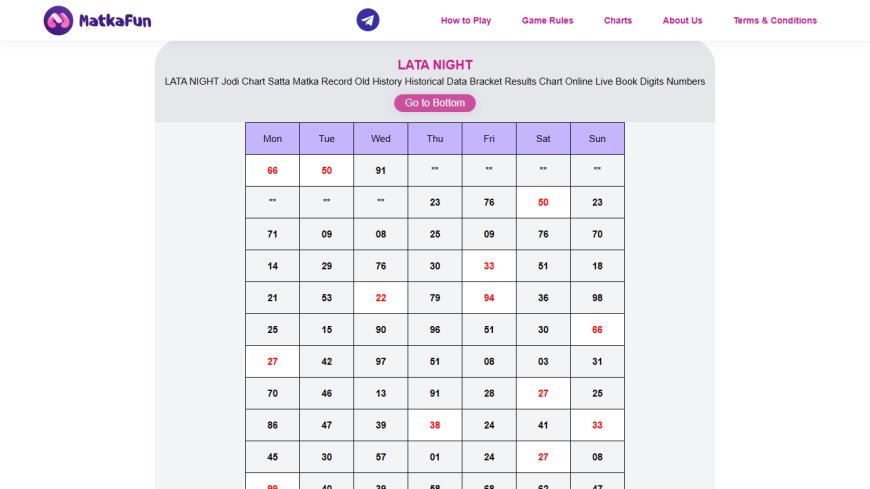
The Lata Night Chart isn’t just a list of numbers — it is a historical record that tells a story. Every result recorded in the chart contributes to a pattern, trend, and number flow that can be studied for insights. Whether you are a beginner or a regular user, understanding the history of the Lata Night Chart and how trends evolve over time can significantly improve your overall chart comprehension.
This guide dives into the history of the lata night chart, explains how past results influence trends, and shows how to analyze those trends methodically. By the end, you’ll have a clearer picture of how the chart works, why patterns appear, and how history can guide better interpretation.
What Is the Lata Night Chart?
Before exploring its history, it’s important to understand what the Lata Night Chart represents.
The Lata Night Chart is a chronological record of nightly results. Each day’s result is entered into the chart in structures such as:
-
Single Digit – a one-digit number (0–9),
-
Jodi – a two-digit combination,
-
Patti (Panel) – a three-digit number.
Together, these formats form a complete record of results over time. What looks like simple numbers actually serves as a data lineage — a historical log showing how results flowed over days, weeks, and months.
Early Days: How the Chart Started
The Lata Night Chart began as a simple, manually maintained log — often kept in notebooks or paper records — where enthusiasts recorded daily results. In the early days:
-
Charts were handwritten, often with minimal structure.
-
There was limited focus on long-term trend analysis.
-
Users depended on memory or manual notes to find old results.
As interest grew, chart keepers standardized the chart format. This shift enabled more organized data storage and made it easier to revisit past results for comparison or pattern study.
Evolution of Chart Record Keeping
With time, the Lata Night Chart evolved through several stages:
1. Manual Logbooks
Initially, players wrote results day by day. These logs lacked consistency and often resulted in missing data or errors.
2. Standardized Tables
To improve clarity, chart templates were introduced. These tables clearly separated dates, singles, jodis, and pattis — making past data easier to analyze.
3. Digital Records
The biggest jump came with digitization:
-
Results were stored in spreadsheets or digital tables.
-
Old charts could be preserved forever with no physical wear.
-
Trends and patterns became easier to compute and visualize.
Today, many platforms use digital charts that update automatically, ensuring accurate history tracking.
Why Past Results Matter
At first glance, past results may seem irrelevant — after all, tomorrow’s outcome is unknown. However, there are several reasons history is crucial:
1. Pattern Recognition
Patterns such as repeating digits, frequent jodis, or recurring patti structures become visible only when viewed over time.
2. Frequency Trends
Some numbers appear more often than others. Historical tracking shows which digits are “hot” and which are “cold.”
3. Gap Analysis
Knowing how many days a particular number has not appeared (gap) helps users understand potential future behavior.
4. Informed Comparison
Comparing similar time frames (weekly, monthly, seasonal) reveals trend shifts or cyclic behaviors.
In short, past results provide context — a framework to see how today’s number fits into a larger picture.
Types of Trends in the Lata Night Chart
When we talk about trends, we identify patterns that appear when results are viewed across time. Here are common types:
1. Repetition Trend
Certain numbers repeat frequently within short spans. For example, a single digit “7” might appear multiple times in a week, suggesting a short-term repetition pattern.
2. Mirror Patterns
Mirror patterns occur when pairs reflect each other — such as 23 and 32 appearing close in time.
3. Gap Trends
A gap trend refers to the number of days a digit has not appeared. Numbers with long gaps might suddenly recur — making gap analysis useful in overall trend study.
4. Running or Sequential Patterns
Sometimes numbers appear sequentially, such as 45 following closely after 44 or 46. These patterns become visible only when looking at historical charts.
5. Cluster Patterns
Cluster patterns are groups of related numbers that appear around similar dates — often seen in weekly or monthly summaries.
How to Analyze Historical Trends
Analyzing past results is not guessing — it is systematic observation. Here’s a thoughtful approach:
Step 1: Gather Data
Collect past results for as many days as possible — weekly, monthly, quarterly, or yearly.
Step 2: Organize by Format
Separate data into single digits, jodis, and pattis. This makes pattern visualization clearer.
Step 3: Look for Repeats
Identify digits or pairs that occur most frequently within your dataset.
Step 4: Check Gaps
Calculate gaps — count how many days it’s been since a number last appeared.
Step 5: Visual Mapping
Use charts or color coding (if digital) to highlight repeating patterns or clusters.
Step 6: Compare Time Frames
Compare current patterns with similar past periods (e.g., same month last year) to identify recurring behaviors.
This analysis helps users see trends that are not obvious from day-to-day viewing.
Case Example: Understanding a Trend
Let’s imagine the following scenario:
-
In January, single digit “5” appears five times.
-
In February, “5” appears only twice.
-
In March, “5” appears seven times.
This indicates a rising frequency trend for digit “5.” While this does not predict future outcomes with certainty, it highlights a historical trend that suggests higher activity around that digit in similar months.
Tools to Support Trend Analysis
Historical trend analysis becomes easier with tools such as:
-
Spreadsheets: for sorting, filtering, and gap counting
-
Graphs & Line Charts: visualize frequency over time
-
Color Coding: highlights repeating numbers
-
Record Logs: date-wise notebooks organized for quick reference
Digitally stored charts make long-term analysis faster and more accurate than manual tracking.
Common Misconceptions About Past Results
It’s important to understand what history does and does not do:
Myth:
Past results guarantee future outcomes.
Reality:
Past results help identify trends, not predict exact future numbers.
Myth:
Patterns always repeat.
Reality:
Patterns may recur, but results can still vary randomly.
Myth:
A number with long gaps is “due.”
Reality:
Gap analysis shows absence, but it doesn’t make events certain.
Understanding these distinctions is key to intelligent analysis — avoiding both overconfidence and confusion.
How History Improves Chart Confidence
A well-studied chart history helps players:
-
Read charts with deeper understanding
-
Avoid impulsive conclusions
-
Focus on data instead of guessing
-
Appreciate number movement over time
This doesn’t mean predicting results — it means interpreting them with intelligence.
Tips to Maintain Your Own Historical Record
For effective trend analysis, keep a personal record:
-
Update your chart daily
-
Mark repeated patterns
-
Note gaps for each digit
-
Review weekly summaries
Even simple entries can develop into powerful historical insights over time.
Final Thoughts
The history of the Lata Night Chart is more than past numbers — it is a data reservoir offering context, trends, and understanding. Exploring past results does not offer certainty, but it enriches your interpretation skills and gives you a broader view of how the chart behaves.
Trend analysis is a process, not a shortcut. By studying history thoughtfully, users gain clarity, perspective, and confidence — turning a chart of numbers into meaningful insight.